Hiring Isn’t Broken.
It’s Behaving Exactly as Its Design Predicts.
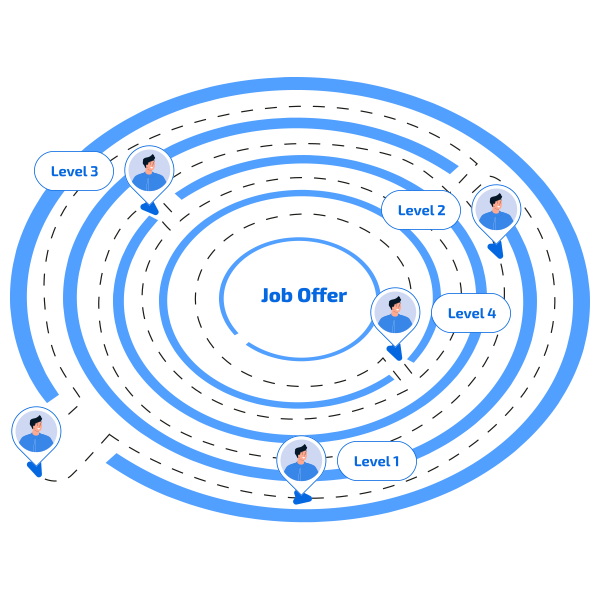
A high-priority role opens.
Energy spikes. Calendars fill instantly. Slack threads multiply like someone typed “urgent” in bold. The job description is sharp. The first candidates look strong.
For a moment, hiring feels effortless.
Clear direction. Fast feedback. Confident decisions.
Then something subtle shifts.
An extra review is added “just to be safe.”
Another stakeholder wants visibility.
Feedback stretches from hours to days.
Approvals sit in inboxes like unread newsletters you’ll definitely open later.
Nothing breaks.
Which is exactly why no one fixes it.
Acceleration fades quietly.
And when acceleration fades without visible failure, the cause is rarely dramatic.
It’s cumulative.
The Addition Reflex
When hiring slows, we rarely subtract.
We add.
Another interview.
Another approval.
Another assessment.
Another dashboard.
It feels responsible.
In 2021, a study published in Nature found that humans systematically overlook subtractive solutions. When improving systems, we instinctively add — even when removing would work better.
This is Additive Bias.
Addition feels active.
Subtraction feels risky.
But hiring systems are cumulative.
Every added layer increases complexity.
Every complexity increases effort.
And effort reshapes behavior.
Momentum doesn’t disappear.
It erodes — one responsible decision at a time.
Which brings us to friction.
How Addition Becomes Friction
Behavioral science gives us a simple equation:
Action = Motivation − Friction
Friction is not dramatic obstruction.
It’s effort.
Cognitive load.
Ambiguity.
Unclear next steps.
Delay loops.
Research on Effort Discounting shows that as required effort increases, perceived value decreases. The harder something feels, the less attractive it becomes — even when the opportunity itself hasn’t changed.
In behavioral systems, effort scales exponentially.
A minor increase in friction can collapse commitment entirely.
Add one more required field to a form, and completion drops.
Add one more approval stage, and decisions stretch.
Not proportionally.
Disproportionately.
Friction cost accumulates quietly.
Which means the next symptom isn’t chaos.
It’s thinning momentum.
When Movement Replaces Momentum
At this point, most teams say:
“But we’re busy.”
Exactly.
Busy is movement.
Momentum is advancement.
Movement | Momentum |
|---|---|
| Interviews scheduled | Decisions made |
Emails exchanged | Confidence strengthened |
Stages completed | Commitment deepened |
Feels heavy | Feels progressive |
Movement fills calendars.
Momentum closes roles.
You don’t lose momentum because the engine failed.
You lose it because the brake was never fully released.
You can have a strong employer brand, capable recruiters, motivated candidates — a perfectly tuned engine.
But if friction is lightly engaged, you’re not accelerating.
You’re burning fuel.
That fuel is attention.
That fuel is enthusiasm.
That fuel is trust.
And once depleted, it rarely replenishes at full strength.
Which raises the deeper structural question:
Why does friction accumulate so easily?
The Drift Toward Entropy
In physics, entropy describes the natural tendency of systems to drift toward disorder. Energy disperses. Structure weakens. Resistance increases.
Hiring behaves the same way.
Without intentional subtraction:
Approvals multiply.
Communication fragments.
Decision cycles stretch.
No one designs inefficiency.
It emerges.
Like opening what was meant to be a “quick” review document and discovering 14 comment threads and three conflicting suggestions.
Individually manageable.
Collectively exhausting.
Entropy in hiring doesn’t look like disorder.
It looks like normal.
Normal delays.
Normal bureaucracy.
Normal caution.
And that normalization feeds friction.
Unless something interrupts the drift.
The Control Illusion
The instinctive response to drift is tighter control.
More oversight.
More validation.
More checkpoints.
Built like vaults.
Secure. Layered. Heavy.
But heavy systems increase cognitive load.
And when cognitive load rises, the brain defaults to lower-effort behavior.
Delay.
“Later” feels rational.
“Later” feels responsible.
But “later” is friction deciding for you.
Candidates delay forms.
Recruiters postpone feedback.
Employers hesitate on offers.
Different roles.
Same mechanism.
This isn’t a motivation failure.
It’s architecture working exactly as it was built.
And architecture determines direction.
The Counterforce Must Be Engineered
If friction accumulates naturally,
ease must be engineered deliberately.
Otherwise, drift becomes the default.
Entropy always wins.
Ease is not cosmetic simplicity.
It is behavioral architecture.
Systems designed to:
-
Reduce cognitive load
-
Shorten delay loops
-
Make progress visible
-
Align incentives with forward motion
Because when effort decreases, action increases.
And when action sustains itself, momentum compounds.
Which is where EASY becomes structural, not symbolic.
EASY as Behavioral Architecture
E – Engagement First
Design the first action to reward participation. Reduce silent gaps.
A – Actionable Transparency
Make the next step unmistakably clear. Replace ambiguity with visible progression.
S – Signals Over Steps
Measure intent, not just compliance. Track responsiveness, not just stage count.
Y – Yield Momentum
Ensure each stage sharpens the decision rather than diluting it.
EASY reduces friction at the structural level.
Reduced friction restores momentum.
Restored momentum counters entropy.
Not by pushing harder.
By redesigning the environment.
Connect EC : The System Built Against Drift
Hiring doesn’t fail loudly.
It slows quietly.
It slows when responsible additions stack into friction.
When effort dilutes intent.
When environment overrides motivation.
When entropy goes unchallenged.
You don’t fix that by pushing harder.
You redesign the architecture.
Because hiring is not a logistics problem.
It is a behavioral environment.
And when the environment aligns with how humans actually decide,
progress doesn’t need to be forced.
It becomes inevitable.
Reduce addition.
Reduce friction.
Restore momentum.
Design the decision.
Connect EC.