Hiring Is a Behavioral Environment
And Behavior Follows Design
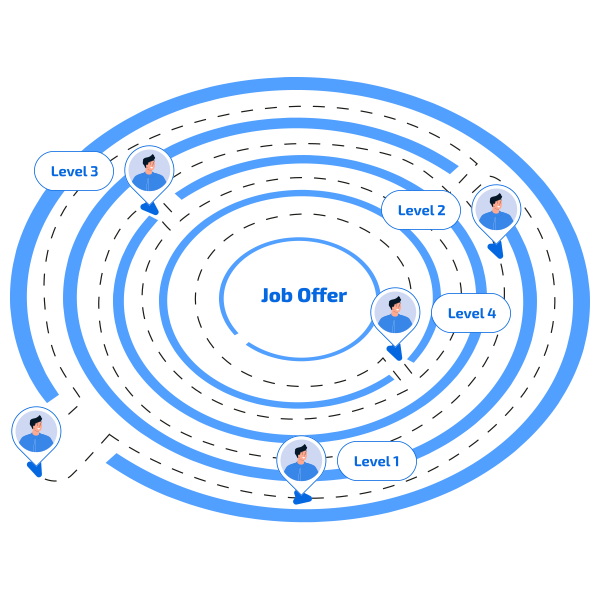
Let’s begin with something simple — and slightly uncomfortable.
Hiring is not an event. It is not a sequence of interviews. It is not a checklist.
Hiring is a behavioral environment.
And behavior follows design.
If hiring feels tense, heavy, or harder than it should — that is not accidental.
If employers experience hiring as risk, recruiters experience it as pressure, and candidates experience it as anxiety,
those are not three separate problems.
They are predictable responses to the same environment.
Different roles. Same nervous system.
And the nervous system responds to signals long before logic enters the room.
When outcomes feel distorted, it is because the environment is producing them — by design, whether intentional or not.
The Law We Ignore: Behavior Is a Function of Environment
Decades ago, one of the founders of modern social psychology, Kurt Lewin, established a principle that still governs human behavior today:
B = f(P, E) Behavior is a function of the Person and their Environment.
Not skill alone. Not intent alone. Not motivation alone.
Environment.
In other words, behavior does not emerge in isolation. It emerges inside forces.
But Lewin made a distinction most hiring systems overlook.
There is the objective environment — what structurally exists. And there is the behavioral environment — what is perceived.
Behavior responds to perception.
Two candidates can experience the same interview differently. One perceives clarity. One perceives threat.
Their behavior will diverge — predictably.
Hiring does not merely evaluate behavior. It shapes it.
What the Brain Experiences in Hiring
We like to believe hiring is rational.
Scorecards. Structured interviews. Competency matrices. Approval workflows.
But before cognition evaluates, biology scans.
When humans perceive social, financial, or reputational consequence, cognition narrows. Exploration contracts. Creativity drops. Risk tolerance shrinks. Delay begins to feel safe.
This is not weakness. It is neurological efficiency.
The brain protects before it optimizes.
Every layer of consequence embedded in hiring is a design decision. And every design decision produces a behavioral response.
Consequence activates protection. Protection reshapes behavior.
What we label as “hiring problems” are often design outputs.
Behavior is not malfunctioning. It is responding.
The Three Predictable Distortions
Employers: When Risk Becomes Constriction
Hiring carries real stakes.
A mis-hire affects performance. A delayed hire affects growth. A rushed hire affects culture.
So the system reacts.
Add oversight. Add consensus. Add checkpoints.
It feels disciplined.
But each added layer increases perceived consequence.
And increased consequence reduces risk tolerance.
Caution gradually becomes hesitation. Indecision begins to feel responsible.
But hesitation is not strategy. It is a defensive adaptation to amplified consequence.
Canonical Principle #1
If the design amplifies consequence, it will amplify avoidance.
Structural Design Correction
Define competency in observable terms before opening a role.
Not personality descriptors. Not cultural shorthand.
Observable behaviors. Decision patterns. Execution signals.
When competency is undefined, decisions default to familiarity. When competency is defined, risk becomes measurable.
This is the shift from Skill-Fit to Environment-Fit.
Talent does not underperform in isolation. It underperforms when design suppresses it.
Recruiters: When Pressure Becomes Reactivity
Recruiters operate inside tension fields designed by others.
Hiring managers want speed. Candidates want clarity. Leadership wants predictability.
Meanwhile:
Feedback drifts. Interviews reschedule. Offers wobble.
Pressure accumulates.
Under sustained pressure, cognitive load increases. When cognitive load increases, humans default to motion.
Follow up again. Remind again. Escalate again.
Motion replaces meaning. Chasing replaces advising.
This is not a capability gap.
It is environmental overload created by fragmented design.
Canonical Principle #2
If the design sustains pressure, it normalizes reactivity.
Structural Design Correction
Identify every moment in your workflow that requires manual chasing.
Chasing is not an accountability failure. It is friction embedded in the system.
When systems depend on effort instead of structure, performance erodes.
Behavior follows design.
Candidates: When Anxiety Becomes Performance
Candidates operate with partial visibility.
They do not see internal deliberations. They see silence.
Ambiguity increases perceived threat faster than rejection does.
Under ambiguity:
Self-monitoring rises. Authenticity drops. Performance intensifies.
You believe you are evaluating capability.
You may be evaluating composure under perceived scrutiny.
Canonical Principle #3
If the design increases ambiguity, it increases defensive behavior.
Structural Design Correction
Replace vague communication with defined timelines and criteria.
Clarity reduces threat instantly.
And when threat decreases, signal improves.
The Intention–Action Gap
Intent is rarely the failure point.
Effort is.
At its simplest:
Action = Motivation − Effort
Increase friction — follow-through drops. Reduce friction — follow-through rises.
Most hiring systems increase effort invisibly:
Email loops. Scheduling delays. Extended decision gaps.
We label it thoroughness.
The brain experiences it as load.
Load erodes follow-through faster than lack of intent ever will.
Prediction can detect drift. Only design prevents it.
The Core Misalignment
Most hiring systems optimize for:
Control. Oversight. Documentation. Abundance of options.
The human brain optimizes for:
Clarity.
Certainty.
Progress.
Psychological safety.
When systems optimize for control while humans optimize for safety, distortion is inevitable.
This is not philosophy.
It is behavioral design.
Behavior follows environment. Environment follows design. Always.
And if anxiety, risk, and pressure are environmental outputs, then clarity, conviction, and momentum can be environmental outputs too.
The Shift: From Managing Hiring to Designing It
Control thinking asks:
“How do we enforce this process?”
Design thinking asks:
“What behaviors is this environment producing?”
That question changes everything.
Instead of adding steps, remove ambiguity. Instead of expanding evaluation, increase signal. Instead of amplifying consequence, define thresholds. Instead of tolerating delay loops, shorten them.
When clarity rises, threat falls. When threat falls, judgment stabilizes. When judgment stabilizes, momentum resumes.
Not forced. Restored.
The E.A.S.Y. Design Architecture
If behavior follows design, hiring must be architected deliberately.
EASY is not simplification. It is structural alignment between environment and cognition.
E – **Engagement **
Does the environment connect candidates to meaning early?
A – **Actionable **
Are ownership boundaries and decision authority explicit?
S – **Signals **
Are expectations and competency markers transparent?
Y – **Yield **
Is there visible reinforcement that effort produces impact?
EASY makes desired behavior the path of least resistance.
Humans gravitate toward cognitive ease. If clarity is easier than avoidance, clarity prevails. If ownership is clearer than delay, ownership rises.
This is not motivational theory.
It is behavioral design.
Connect EC operationalizes this architecture directly within the hiring workflow.
Instead of asking employers to decide faster, recruiters to chase less, or candidates to “stay engaged,” the system reshapes the environment itself — embedding engagement, accountability, signal clarity, and yield visibility into every interaction.
The goal is not to push behavior.
It is to make the right behavior easier.
When design changes, behavior follows.
The Inevitable Conclusion
Hiring is not malfunctioning.
It is behaving exactly as it has been designed to behave.
Risk. Pressure. Anxiety.
Not character flaws. Not talent shortages. Not motivation gaps.
Design outputs.
When design misaligns with human cognition, distortion appears.
When design aligns, clarity returns.
Candidates reveal more. Recruiters regain conviction. Employers decide with confidence.
Not because standards lowered.
Because interference reduced.
It responds.
Design the environment. Behavior will follow.
Connect EC exists to make that design operational.