The Architecture of Motivation
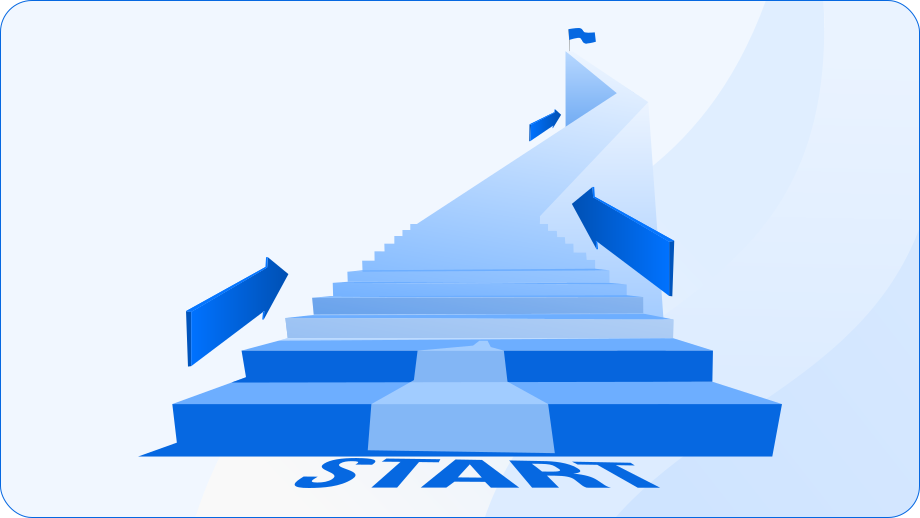
Why Motivation Often Fails Long Before We Stop Caring
You can genuinely want something — and still stop doing the things that could help you achieve it.
You decide that this time will be different.
You buy a gym membership, get new shoes, and make time in your schedule. For the first few weeks, everything feels possible. You are motivated, and you are taking action.
Then one day, you miss a session.
You plan to go tomorrow. But tomorrow becomes next week, and next week becomes next month.
The membership remains active. You still want to become healthier.
But the movement has stopped.
The Same Pattern Appears Across Careers and Hiring
The same experience can unfold in your career or across a hiring process.
Candidate — When Intention Doesn't Become Action
You want a better job.
You update your resume, apply for opportunities, and accept an interview.
Then a busy week arrives. Preparation gets postponed, your availability changes, and the interview day approaches.
You still want the opportunity.
But you don't show up.
Recruiter — When Urgency Doesn't Become Follow-Through
You want to close an urgent role.
You leave a hiring meeting feeling motivated. The targets are clear, and you know exactly what needs to happen next.
But as the day progresses, interviews get rescheduled, feedback gets delayed, and the actions you intended to take get pushed aside.
You still want to close the role.
But the movement doesn't continue.
Employer — When a Decision Remains on Hold
You urgently need the right talent.
The interviews are complete, the preferred candidate is identified, and the hiring need remains critical.
But additional discussions and competing priorities delay the final decision.
You still need the hire.
But the decision remains on hold.
Different situations.
The same difficult question:
If we still want the outcome, why do we stop moving toward it?
Starting Is Not the Same as Continuing
The usual explanation is simple:
“The motivation wore off.”
And sometimes, it did.
The energy that made the first action feel easy may have weakened. Other priorities may have taken over. Circumstances may have changed.
But losing motivation does not necessarily mean losing the objective.
You can stop feeling motivated without stopping caring about the outcome.
You may still want to become healthier, find a better job, close an urgent role, or hire the right candidate.
The objective can remain important even when the actions needed to achieve it no longer continue.
That is the distinction we often overlook.
Motivation Can Help You Begin
Motivation can create the energy for the first action.
But beginning something does not mean the next action will automatically follow.
The first workout proves you started exercising.
It doesn't mean you will return next week.
Starting creates movement.
Continuing requires that movement to carry forward.
And that is where Continuity matters.
What Happens When Circumstances Change?
Consider a candidate who accepts an interview.
When the invitation arrives, the opportunity feels important. The candidate accepts with every intention of attending.
Then the situation changes.
Work becomes demanding. Another interview overlaps the schedule. Preparation gets postponed.
The candidate may still want the opportunity, but the earlier decision now has to carry through a different set of circumstances.
The same challenge appears in recruitment.
A recruiter leaves a hiring meeting knowing exactly what needs to happen next. But the working day introduces competing demands, and the actions planned during the meeting get pushed aside.
An employer may remain committed to filling a critical role while additional discussions, changing priorities, or unresolved questions delay the hiring decision.
In each situation, the goal may remain important.
But the next action is no longer connected as clearly to what was originally intended.
That does not necessarily mean someone stopped caring.
It means that wanting an outcome, making a decision, and following through are different parts of the journey.
And Those Parts Need to Remain Connected
Circumstances change.
Priorities change.
Information changes.
Decisions may change.
But progress still depends on maintaining a connection between what was intended and what happens next.
That connection is Continuity.
The Missing Connection: Continuity
Imagine accepting an interview with every intention of attending.
But when the interview day arrives, you don't show up.
The visible outcome is an interview no-show.
Yet the earlier intention and decision may have been genuine.
From Intention to Action

INTENTION
You want to attend the interview.

DECISION
You accept the interview invitation.

CONTINUITY BREAK
The decision does not carry through to attendance.
The intention existed.
The decision was made.
But the decision did not carry through to the next action.
That missing connection is what Connect EC describes as a continuity break.
The same principle applies when a recruiter intends to update a candidate but never sends the feedback, or when an employer identifies the preferred candidate but leaves the hiring decision pending.
The intention may still exist.
The next action may still be necessary.
But the movement from one to the other has stopped.
Continuity Carries Movement Forward
Continuity keeps one step connected to the next, allowing progress to carry forward even as circumstances change.
It is not simply about maintaining the same level of motivation every day.
It is about keeping progress connected as information, priorities, circumstances, and decisions change.
Motivation
Begins movement.
Continuity
Carries movement forward.
Alignment
Keeps that movement connected as circumstances change.
This distinction matters because motivation is not always something we can sustain at the same intensity.
Continuity provides another way to think about progress.
Instead of asking only:
“How do I stay motivated?”
we can also ask:
“What needs to remain connected for the next action to happen?”
Where Alignment Matters
If Continuity carries movement forward, what helps preserve it when circumstances change?
Alignment.
Alignment keeps what we understand, intend, decide, and do sufficiently connected to support the next action.
Across hiring, this means keeping the different parts of each actor's journey connected as circumstances evolve.
How Alignment Preserves Continuity
CANDIDATE
Keeps career intentions, interview decisions, and subsequent actions connected as circumstances change.
RECRUITER
Keeps hiring priorities connected to the coordination, feedback, and follow-through needed to move roles forward.
EMPLOYER
Keeps business needs, candidate evaluations, hiring decisions, and subsequent actions connected as hiring conditions evolve.
Alignment does not mean circumstances will remain unchanged or that every original decision must be followed without reconsideration.
Sometimes, new information makes changing a decision the appropriate action.
What matters is that the next action remains connected to an informed decision rather than being lost as the situation changes.
That is how Alignment helps preserve Continuity.
The Connect EC Perspective
When progress stops, our first instinct is often to search for more motivation.
We try to recreate the enthusiasm we felt when we started.
But before trying to feel motivated again, there may be a more useful question:
What stopped the intention or decision from becoming the next action?
The answer may be different for each actor.
For a candidate
An unresolved concern, changing availability, or uncertainty about the opportunity.
For a recruiter
Competing priorities, delayed feedback, or an action that repeatedly gets pushed aside.
For an employer
Unclear selection criteria, unresolved expectations, or a pending hiring decision.
The purpose is not to assume that every delay has the same explanation.
It is to recognise that losing movement and losing the objective are not necessarily the same thing.
Once that distinction becomes clear, attention can shift from simply trying to restore motivation to understanding what is preventing progress from continuing.
And that changes how we think about hiring.
Every Stage Needs to Remain Connected
An accepted interview still has to become participation.
A completed interview still has to lead to the next decision.
An accepted offer still has to carry through to joining.
Every stage needs to remain connected to what follows.
Because wanting the outcome is only part of the journey.
Motivation
Begins movement.
Continuity
Carries it forward.
Alignment
Preserves that Continuity as circumstances change.
Progress depends on what happens next.
Experience Hiring Alignment.
Connect EC® | The Hiring Alignment System™
Alignment Preserves Continuity
Recent Blogs
The Architecture of Habit
Why Successful Behaviors Quietly Stop Producing Desired Outcomes: You have probably experienced this before.

The Architecture of Reminders
Why More Reminders Rarely Create More Behavior: You have probably experienced this before.
The Architecture of Motivation
Why Motivation Often Fails Long Before We Stop Caring: You have probably experienced this before.