Struggling to Decode Candidate Ghosting?
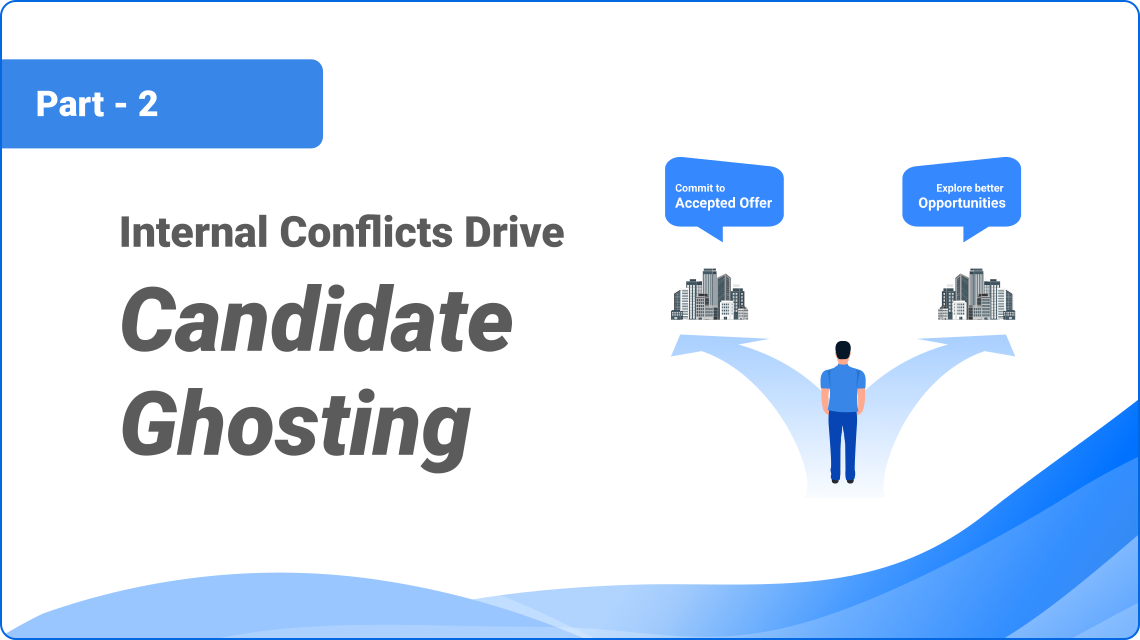
The Honesty Heist: How Internal Struggles Fuel Candidate Ghosting
The Honesty Heist: How Internal Struggles Fuel Candidate Ghosting
But while we chuckle at the external chaos, let's spare a thought for Sparky. What’s the internal cocktail of stress, emotion, self-justification, and good old-fashioned panic swirling behind those polite thank-you emails and suspiciously enthusiastic "super excited to join!" emojis? To truly understand the elusive honest candidate, we must venture into the fascinating labyrinth of their mind.
Welcome back to Part 2, where we (metaphorically speaking, of course – no actual brain surgery will be performed, despite how tempting the hiring process can sometimes make it seem) crack open Sparky’s skull and take a slightly terrified peek inside. Prepare yourselves: it's likely messier than a toddler’s glitter-and-glue art project gone rogue. Because while society might construct the stage, complete with trapdoors for disappearing candidates, the performance itself is a solo act, directed by the complex and often contradictory workings of the human psyche.
So, grab your metaphorical spelunking gear and a generous dose of empathy. Let's descend into the psychological theories that might illuminate why discovering honest talent sometimes feels like pinpointing a specific grain of sand on an exceptionally vast beach.
Psychological Theories Explaining Why Sparky Ghosted (Or Didn't): A Peek Inside Their Mind
1 Cognitive Dissonance Theory (Leon Festinger) – The Internal Tug of War: "My Actions Don't Match My Beliefs? No Problem, I'll Just Rewrite My Beliefs!"
- Founder: Leon Festinger (Social Psychologist)
- Core Idea: We experience psychological discomfort, or cognitive dissonance when our actions clash with our beliefs or values. Think of it as your brain throwing an internal hissy fit because things aren't lining up. To restore peace, the brain becomes a master of mental contortion, often twisting beliefs or justifying behavior to create internal harmony – even if it's a slightly warped version of it.
- In Sparky’s Case: Imagine Sparky feels a tiny pang of guilt about ghosting, a little voice whispering, "Hey, you said you'd join." But this clashes with the overwhelming allure of that other, shinier offer. To silence that nagging voice, Sparky’s brain might engage in some Olympic-level rationalization. They might think, “Well, they probably found someone better anyway,” or “It’s just a job offer; it’s not like I promised them my kidney.” This allows Sparky to sleep soundly without confronting the discomfort of breaking their (albeit verbal) commitment. Consequently, finding honest talent often boils down to identifying individuals with a lower tolerance for this kind of mental gymnastics.
- In Sparky’s Rationalization: "Look, I wasn't being rude; I was proactively optimizing my life trajectory. Besides, in this dog-eat-dog market, they wouldn’t hesitate to rescind the offer if a cheaper candidate walked through the door. It’s not personal, it’s just… strategic career management."
The ability to rationalize conflicting thoughts often stems from a deeper need to feel in control and effective in one's choices, as highlighted by the next theory.
2 Self-Determination Theory (Edward Deci & Richard Ryan) – The Internal Tug of War: "My Actions Don't Match My Beliefs? No Problem, I'll Just Rewrite My Beliefs!"
- Founder: Leon Festinger (Social Psychologist)
- Core Idea: We experience psychological discomfort, or cognitive dissonance when our actions clash with our beliefs or values. Think of it as your brain throwing an internal hissy fit because things aren't lining up. To restore peace, the brain becomes a master of mental contortion, often twisting beliefs or justifying behavior to create internal harmony – even if it's a slightly warped version of it.
- In Sparky’s Case: Imagine Sparky feels a tiny pang of guilt about ghosting, a little voice whispering, "Hey, you said you'd join." But this clashes with the overwhelming allure of that other, shinier offer. To silence that nagging voice, Sparky’s brain might engage in some Olympic-level rationalization. They might think, “Well, they probably found someone better anyway,” or “It’s just a job offer; it’s not like I promised them my kidney.” This allows Sparky to sleep soundly without confronting the discomfort of breaking their (albeit verbal) commitment. Consequently, finding honest talent often boils down to identifying individuals with a lower tolerance for this kind of mental gymnastics.
- Sparky’s Rationalization: "Look, I wasn't being rude; I was proactively optimizing my life trajectory. Besides, in this dog-eat-dog market, they wouldn’t hesitate to rescind the offer if a cheaper candidate walked through the door. It’s not personal, it’s just… strategic career management."
The ability to rationalize conflicting thoughts often stems from a deeper need to feel in control and effective in one's choices, as highlighted by the next theory.
3 The Social Exchange Theory (George Homans) – What’s In It for Me? The Ultimate Internal Cost-Benefit Analysis
- Founder: George Homans (Sociologist)
- Core Idea: We engage in relationships, whether personal or professional, as long as the perceived rewards outweigh the perceived costs. It's the ultimate internal ledger. The moment the costs start to outweigh the benefits, individuals might withdraw or act in a way that minimizes their personal loss. Consider it an internal ROI calculation for every interaction.
- In Sparky’s Case: Sparky might meticulously weigh the costs of honoring your job offer (e.g., potentially lower salary, less exciting work, longer commute, the sheer awkwardness of declining the other offer) against the perceived rewards (the initial excitement of a new job, the promise of a paycheck). If the reward of the new job – perhaps a higher salary, better growth opportunities, or even just free artisanal coffee – significantly outweighs the perceived costs in their internal calculus, Sparky might ghost because the benefits of the new offer seem to dwarf any potential guilt or discomfort associated with reneging on their initial commitment. An honest candidate, however, will ideally weigh more than just immediate personal gain in their decision-making process.
- Sparky’s Cost-Benefit Analysis: "This new role gives me significantly more money, a clearer path for career growth, and they even have a nap room! Sorry, original company, but my personal happiness and LinkedIn profile are my top priorities right now. The numbers don't lie."
Interestingly, sometimes this internal justification involves subtly shifting blame, a phenomenon explored in the following theory.
4 Projection (Sigmund Freud) – Blaming Others For Your Own Issues: "It's Not My Fault I'm Ghosting, It's Their Fault For Not Being Good Enough!"
- Founder: Sigmund Freud (Psychoanalyst)
- Core Idea: Projection involves attributing your own unwanted feelings, impulses, or actions to others. It’s like your internal blame-deflection shield. When someone struggles to accept their own shortcomings or ethically questionable actions, they project those feelings onto others, effectively making it their problem instead.
- In Sparky’s Case: Sparky might feel a fleeting pang of guilt or discomfort about their decision to ghost. But instead of accepting responsibility for their actions ("I committed and I'm breaking it"), they might project their discomfort onto you, thinking, “They’re probably used to being ghosted; it’s just the brutal reality of this industry. It’s really not that big of a deal.” This allows Sparky to sidestep confronting their own less-than-stellar behavior. Finding honest talent often involves individuals with a strong sense of personal accountability.
- Sparky’s Inner Thoughts: "They've probably interviewed hundreds of people; one less isn't going to derail their entire quarter. Besides, their interview process was a tad disorganized anyway. They probably won't even notice I'm gone. It's practically an unspoken expectation in this crazy market."
Conversely, when things don't go their way, individuals might externalize blame, as highlighted by the fundamental attribution error.
5 The Fundamental Attribution Error (Lee Ross) – It’s Never My Fault: "If Only They Had Made a Better Offer, I Wouldn't Be Forced to Do This!"
- Founder: Lee Ross (Psychologist)
- Core Idea: We tend to overestimate the influence of dispositional factors (personality, character) on others’ behaviors while underestimating situational factors (context or environment). Essentially, when explaining other people's actions, we jump to conclusions about their inherent character, but when explaining our own actions, we readily blame the situation.
- In Sparky’s Case: When Sparky decides to ghost, they might internally wrestle with a fleeting sense of personal responsibility. However, when explaining it – even if only to themselves – they’ll likely frame your company’s situation as the primary driver: "You didn’t offer me a competitive enough package." "You didn’t make me feel sufficiently valued." "Their Glassdoor reviews were a little concerning, anyway." Sparky might rationalize their behavior, subtly shifting the blame and believing you are at least partially responsible for their (lack of) honesty. Therefore, finding honest talent involves identifying individuals who readily take ownership of their commitments.
- Sparky’s Self-Talk: "I wouldn’t have to engage in this uncomfortable ghosting if they had just offered a more competitive salary or a better work-life balance. It’s not really my fault; they didn’t exactly make it easy for me to say a resounding yes."
Adding to this complexity is the feeling of being overwhelmed by choices can also lead to a more general state of cognitive overload, impacting decision-making.
6 The Cognitive Load Theory (John Sweller) – Overloaded Minds Make Bad Decisions: "Too Many Choices! My Brain Just Short-Circuited, So I'm Just Going to… Not Decide."
- Founder: John Sweller (Educational Psychologist)
- Core Idea: When our cognitive load – the mental effort required to process information and make decisions – becomes excessively high, our decision-making abilities suffer. Our brains, feeling overwhelmed and stretched thin, tend to default to the path of least resistance, even if it isn't the most ethical or thoughtful route.
- In Sparky’s Case: Sparky might be juggling multiple job offers, each accompanied by its own intricate web of pros and cons, salary figures, benefits packages, and start dates. This significant mental overload, compounded by the inherent stress of interviews and potentially managing their current job, can easily lead to decision paralysis. The uncomfortable task of formally declining an offer or articulating a change of heart only adds to this already substantial cognitive burden. In this state of mental overload, ghosting can feel like the simplest way to reduce cognitive load – a way to sidestep the difficult and mentally taxing conversation altogether. An honest candidate, even when navigating stressful situations, will prioritize clear and respectful communication.
- Sparky’s Rationalization: "Ugh, all these spreadsheets and comparisons are making my head spin. I just… can’t process another phone call right now. I’ll figure it out later… maybe."
Our inherent tendency to view ourselves in a positive light can further complicate the issue of accountability.
7 The Self-Serving Bias (Miller & Ross) – It’s Always Someone Else’s Fault (Especially When Things Go Wrong): "If This Other Job Turns Out Great, It's Because I'm Brilliant. If This One Didn't, Well… They Just Weren't the Right Fit for My Genius."
- Founder: Miller & Ross (Psychologists)
- Core Idea: We humans have a natural inclination to take credit for our successes while conveniently attributing our failures to external factors. It’s the mental equivalent of always landing on "Go" in a real-life game of Monopoly.
- In Sparky’s Case: Sparky might rationalize their ghosting as a direct result of circumstances entirely beyond their control. If they accept your offer and it ultimately proves to be a poor fit, they’ll likely point fingers at the company culture, the misleading job description, or the hiring manager's less-than-stellar communication style. But when things go swimmingly with the other job they ghosted you for? That’s solely attributable to their exceptional decision-making prowess and inherent brilliance. This self-serving bias allows them to maintain a positive self-image while potentially engaging in less-than-honest behavior.
- Sparky’s Self-Talk: "If this fantastic new job works out brilliantly, it's all thanks to my incredible intuition and foresight! But if that other job didn't feel quite right from the beginning, well… that’s certainly not on me. They simply failed to recognize my true potential."
Adding to this complexity is the modern phenomenon of having too many options, which can lead to a unique form of paralysis.
8 The Fear Of Better Options (FOBO) – Paralyzed by Possibilities, Leading to… Silence. "So many amazing opportunities! My brain just froze, so I'm just going to… Not Respond."
- Founder: Patrick McGinnis (Venture Capitalist and Author)
- FOBO : Fear Of a Better Option - "OMG, So Many Choices! I Can't Even!"
- Coined By: Patrick McGinnis (A very relatable human)
- The Gist: FOBO is that persistent feeling that no matter what you choose, there's always a potentially superior option lurking just around the corner. It's the very reason you spend three hours scrolling through Netflix, paralyzed by the sheer volume of choices, and ultimately end up watching nothing. In the context of hiring, FOBO emerges as a significant, albeit often subconscious, driver of indecision and, consequently, ghosting. This isn't necessarily about a fundamental lack of integrity, but rather an internal anxiety stemming from the overwhelming abundance of choices in today's competitive job market.
- Sparky's Struggle: Picture Sparky, confronted with a dazzling array of seemingly amazing job offers. Each one gleams with its own unique set of perks and promises. Sparky's brain essentially short-circuits: "What if I commit to this one, and the perfect job was actually that one?!" This mental quagmire leads to decision paralysis, and Sparky ultimately ends up ghosting everyone because the sheer act of choosing feels overwhelmingly consequential. This internal struggle isn't a simple matter of choosing between a good and a bad option but rather navigating a dizzying landscape of potentially great options.
- Sparky's Inner Monologue: "Ugh, this is just too much. Free snacks are cool, but what if another company has a nap room and a ball pit? Wow, Company A boasts incredible growth potential, but Company B offers that elusive work-life balance... and Company C's mission truly resonates with my soul. What if I pick one, and then the absolutely perfect role at a secret Company D magically appears next week? Ugh, I simply cannot decide. Maybe if I just... wait a little longer... they'll all just sort of... resolve themselves?"
Wrapping It All Up: The Mind Games We Play (Especially When Job Offers Are Involved)
These psychological theories offer us a fascinating glimpse into the "why behind the why"—the intricate mental mechanisms Sparky (and, let's be honest, all of us to some extent) employs to justify or explain their behavior. It's not solely about external pressures or a simple lack of ethical values; it's the complex mind games unfolding inside Sparky’s head that significantly influence their actions, sometimes leading them down the less-than-honest path of ghosting.
Whether they choose silence due to the internal conflict created by cognitive dissonance, the ego-protecting mechanisms of the self-serving bias, or the way the endowment effect makes a future prospect feel inherently more valuable than a present commitment, Sparky’s choices are deeply intertwined with their self-perception, their strategies for managing stress and conflicting desires, and what they ultimately believe they deserve in the high-stakes arena of career advancement. Understanding these internal drivers is paramount in our ongoing quest to attract and retain truly honest talent.
In Sparky’s world (and indeed, in the world of many candidates navigating the complexities of the modern job market), the landscape within their own mind is just as intricate and often contradictory as the chaotic hiring circus we’ve described.
Final Thought: Sparky’s Brain Is Just Trying to Survive, Too (Just Like the Rest of Us)
Is Sparky inherently malicious? A corporate caricature twirling a metaphorical mustache? Probably not. They’re likely just a messy, multifaceted human being grappling with internal conflicts, attempting to rationalize decisions, justify actions, and strategically navigate a world that often feels faster, harsher, and more unpredictable than ever before. The alluring siren call of a perceived "better" opportunity can trigger a cascade of complex psychological responses, sometimes overpowering the quieter voice of commitment and honesty.
If external forces constructed the chaotic Hiring Circus… internal forces, the intricate and often unconscious workings of the human mind, have inadvertently taught Sparky to juggle flaming torches of opportunity while simultaneously whistling motivational tunes about self-advancement.
So, if we genuinely aspire to cultivate more honesty in hiring and nurture a pool of truly reliable talent? We can’t simply castigate Sparky’s individual choices without acknowledging and understanding the powerful internal forces that shape those very choices. We must delve into the fascinating and sometimes frustrating world that exists within Sparky’s brain.
(And perhaps, in a gesture of understanding, send a virtual fruit basket to their undoubtedly overwhelmed prefrontal cortex, along with a gentle reminder that clear and timely communication is always the most valuable asset in navigating this complex dance.)
Employers Solution01/02
Employers
The Honesty Heist: How Internal Struggles Fuel Candidate Ghosting
The Honesty Heist: How Internal Struggles Fuel Candidate Ghosting
But while we chuckle at the external chaos, let's spare a thought for Sparky. What’s the internal cocktail of stress, emotion, self-justification, and good old-fashioned panic swirling behind those polite thank-you emails and suspiciously enthusiastic "super excited to join!" emojis? To truly understand the elusive honest candidate, we must venture into the fascinating labyrinth of their mind.
Welcome back to Part 2, where we (metaphorically speaking, of course – no actual brain surgery will be performed, despite how tempting the hiring process can sometimes make it seem) crack open Sparky’s skull and take a slightly terrified peek inside. Prepare yourselves: it's likely messier than a toddler’s glitter-and-glue art project gone rogue. Because while society might construct the stage, complete with trapdoors for disappearing candidates, the performance itself is a solo act, directed by the complex and often contradictory workings of the human psyche.
So, grab your metaphorical spelunking gear and a generous dose of empathy. Let's descend into the psychological theories that might illuminate why discovering honest talent sometimes feels like pinpointing a specific grain of sand on an exceptionally vast beach.
Psychological Theories Explaining Why Sparky Ghosted (Or Didn't): A Peek Inside Their Mind
1 Cognitive Dissonance Theory (Leon Festinger) – The Internal Tug of War: "My Actions Don't Match My Beliefs? No Problem, I'll Just Rewrite My Beliefs!"
- Founder: Leon Festinger (Social Psychologist)
- Core Idea: We experience psychological discomfort, or cognitive dissonance when our actions clash with our beliefs or values. Think of it as your brain throwing an internal hissy fit because things aren't lining up. To restore peace, the brain becomes a master of mental contortion, often twisting beliefs or justifying behavior to create internal harmony – even if it's a slightly warped version of it.
- In Sparky’s Case: Imagine Sparky feels a tiny pang of guilt about ghosting, a little voice whispering, "Hey, you said you'd join." But this clashes with the overwhelming allure of that other, shinier offer. To silence that nagging voice, Sparky’s brain might engage in some Olympic-level rationalization. They might think, “Well, they probably found someone better anyway,” or “It’s just a job offer; it’s not like I promised them my kidney.” This allows Sparky to sleep soundly without confronting the discomfort of breaking their (albeit verbal) commitment. Consequently, finding honest talent often boils down to identifying individuals with a lower tolerance for this kind of mental gymnastics.
- In Sparky’s Rationalization: "Look, I wasn't being rude; I was proactively optimizing my life trajectory. Besides, in this dog-eat-dog market, they wouldn’t hesitate to rescind the offer if a cheaper candidate walked through the door. It’s not personal, it’s just… strategic career management."
The ability to rationalize conflicting thoughts often stems from a deeper need to feel in control and effective in one's choices, as highlighted by the next theory.
2 Self-Determination Theory (Edward Deci & Richard Ryan) – The Internal Tug of War: "My Actions Don't Match My Beliefs? No Problem, I'll Just Rewrite My Beliefs!"
- Founder: Leon Festinger (Social Psychologist)
- Core Idea: We experience psychological discomfort, or cognitive dissonance when our actions clash with our beliefs or values. Think of it as your brain throwing an internal hissy fit because things aren't lining up. To restore peace, the brain becomes a master of mental contortion, often twisting beliefs or justifying behavior to create internal harmony – even if it's a slightly warped version of it.
- In Sparky’s Case: Imagine Sparky feels a tiny pang of guilt about ghosting, a little voice whispering, "Hey, you said you'd join." But this clashes with the overwhelming allure of that other, shinier offer. To silence that nagging voice, Sparky’s brain might engage in some Olympic-level rationalization. They might think, “Well, they probably found someone better anyway,” or “It’s just a job offer; it’s not like I promised them my kidney.” This allows Sparky to sleep soundly without confronting the discomfort of breaking their (albeit verbal) commitment. Consequently, finding honest talent often boils down to identifying individuals with a lower tolerance for this kind of mental gymnastics.
- Sparky’s Rationalization: "Look, I wasn't being rude; I was proactively optimizing my life trajectory. Besides, in this dog-eat-dog market, they wouldn’t hesitate to rescind the offer if a cheaper candidate walked through the door. It’s not personal, it’s just… strategic career management."
The ability to rationalize conflicting thoughts often stems from a deeper need to feel in control and effective in one's choices, as highlighted by the next theory.
3 The Social Exchange Theory (George Homans) – What’s In It for Me? The Ultimate Internal Cost-Benefit Analysis
- Founder: George Homans (Sociologist)
- Core Idea: We engage in relationships, whether personal or professional, as long as the perceived rewards outweigh the perceived costs. It's the ultimate internal ledger. The moment the costs start to outweigh the benefits, individuals might withdraw or act in a way that minimizes their personal loss. Consider it an internal ROI calculation for every interaction.
- In Sparky’s Case: Sparky might meticulously weigh the costs of honoring your job offer (e.g., potentially lower salary, less exciting work, longer commute, the sheer awkwardness of declining the other offer) against the perceived rewards (the initial excitement of a new job, the promise of a paycheck). If the reward of the new job – perhaps a higher salary, better growth opportunities, or even just free artisanal coffee – significantly outweighs the perceived costs in their internal calculus, Sparky might ghost because the benefits of the new offer seem to dwarf any potential guilt or discomfort associated with reneging on their initial commitment. An honest candidate, however, will ideally weigh more than just immediate personal gain in their decision-making process.
- Sparky’s Cost-Benefit Analysis: "This new role gives me significantly more money, a clearer path for career growth, and they even have a nap room! Sorry, original company, but my personal happiness and LinkedIn profile are my top priorities right now. The numbers don't lie."
Interestingly, sometimes this internal justification involves subtly shifting blame, a phenomenon explored in the following theory.
4 Projection (Sigmund Freud) – Blaming Others For Your Own Issues: "It's Not My Fault I'm Ghosting, It's Their Fault For Not Being Good Enough!"
- Founder: Sigmund Freud (Psychoanalyst)
- Core Idea: Projection involves attributing your own unwanted feelings, impulses, or actions to others. It’s like your internal blame-deflection shield. When someone struggles to accept their own shortcomings or ethically questionable actions, they project those feelings onto others, effectively making it their problem instead.
- In Sparky’s Case: Sparky might feel a fleeting pang of guilt or discomfort about their decision to ghost. But instead of accepting responsibility for their actions ("I committed and I'm breaking it"), they might project their discomfort onto you, thinking, “They’re probably used to being ghosted; it’s just the brutal reality of this industry. It’s really not that big of a deal.” This allows Sparky to sidestep confronting their own less-than-stellar behavior. Finding honest talent often involves individuals with a strong sense of personal accountability.
- Sparky’s Inner Thoughts: "They've probably interviewed hundreds of people; one less isn't going to derail their entire quarter. Besides, their interview process was a tad disorganized anyway. They probably won't even notice I'm gone. It's practically an unspoken expectation in this crazy market."
Conversely, when things don't go their way, individuals might externalize blame, as highlighted by the fundamental attribution error.
5 The Fundamental Attribution Error (Lee Ross) – It’s Never My Fault: "If Only They Had Made a Better Offer, I Wouldn't Be Forced to Do This!"
- Founder: Lee Ross (Psychologist)
- Core Idea: We tend to overestimate the influence of dispositional factors (personality, character) on others’ behaviors while underestimating situational factors (context or environment). Essentially, when explaining other people's actions, we jump to conclusions about their inherent character, but when explaining our own actions, we readily blame the situation.
- In Sparky’s Case: When Sparky decides to ghost, they might internally wrestle with a fleeting sense of personal responsibility. However, when explaining it – even if only to themselves – they’ll likely frame your company’s situation as the primary driver: "You didn’t offer me a competitive enough package." "You didn’t make me feel sufficiently valued." "Their Glassdoor reviews were a little concerning, anyway." Sparky might rationalize their behavior, subtly shifting the blame and believing you are at least partially responsible for their (lack of) honesty. Therefore, finding honest talent involves identifying individuals who readily take ownership of their commitments.
- Sparky’s Self-Talk: "I wouldn’t have to engage in this uncomfortable ghosting if they had just offered a more competitive salary or a better work-life balance. It’s not really my fault; they didn’t exactly make it easy for me to say a resounding yes."
Adding to this complexity is the feeling of being overwhelmed by choices can also lead to a more general state of cognitive overload, impacting decision-making.
6 The Cognitive Load Theory (John Sweller) – Overloaded Minds Make Bad Decisions: "Too Many Choices! My Brain Just Short-Circuited, So I'm Just Going to… Not Decide."
- Founder: John Sweller (Educational Psychologist)
- Core Idea: When our cognitive load – the mental effort required to process information and make decisions – becomes excessively high, our decision-making abilities suffer. Our brains, feeling overwhelmed and stretched thin, tend to default to the path of least resistance, even if it isn't the most ethical or thoughtful route.
- In Sparky’s Case: Sparky might be juggling multiple job offers, each accompanied by its own intricate web of pros and cons, salary figures, benefits packages, and start dates. This significant mental overload, compounded by the inherent stress of interviews and potentially managing their current job, can easily lead to decision paralysis. The uncomfortable task of formally declining an offer or articulating a change of heart only adds to this already substantial cognitive burden. In this state of mental overload, ghosting can feel like the simplest way to reduce cognitive load – a way to sidestep the difficult and mentally taxing conversation altogether. An honest candidate, even when navigating stressful situations, will prioritize clear and respectful communication.
- Sparky’s Rationalization: "Ugh, all these spreadsheets and comparisons are making my head spin. I just… can’t process another phone call right now. I’ll figure it out later… maybe."
Our inherent tendency to view ourselves in a positive light can further complicate the issue of accountability.
7 The Self-Serving Bias (Miller & Ross) – It’s Always Someone Else’s Fault (Especially When Things Go Wrong): "If This Other Job Turns Out Great, It's Because I'm Brilliant. If This One Didn't, Well… They Just Weren't the Right Fit for My Genius."
- Founder: Miller & Ross (Psychologists)
- Core Idea: We humans have a natural inclination to take credit for our successes while conveniently attributing our failures to external factors. It’s the mental equivalent of always landing on "Go" in a real-life game of Monopoly.
- In Sparky’s Case: Sparky might rationalize their ghosting as a direct result of circumstances entirely beyond their control. If they accept your offer and it ultimately proves to be a poor fit, they’ll likely point fingers at the company culture, the misleading job description, or the hiring manager's less-than-stellar communication style. But when things go swimmingly with the other job they ghosted you for? That’s solely attributable to their exceptional decision-making prowess and inherent brilliance. This self-serving bias allows them to maintain a positive self-image while potentially engaging in less-than-honest behavior.
- Sparky’s Self-Talk: "If this fantastic new job works out brilliantly, it's all thanks to my incredible intuition and foresight! But if that other job didn't feel quite right from the beginning, well… that’s certainly not on me. They simply failed to recognize my true potential."
Adding to this complexity is the modern phenomenon of having too many options, which can lead to a unique form of paralysis.
8 The Fear Of Better Options (FOBO) – Paralyzed by Possibilities, Leading to… Silence. "So many amazing opportunities! My brain just froze, so I'm just going to… Not Respond."
- Founder: Patrick McGinnis (Venture Capitalist and Author)
- FOBO : Fear Of a Better Option - "OMG, So Many Choices! I Can't Even!"
- Coined By: Patrick McGinnis (A very relatable human)
- The Gist: FOBO is that persistent feeling that no matter what you choose, there's always a potentially superior option lurking just around the corner. It's the very reason you spend three hours scrolling through Netflix, paralyzed by the sheer volume of choices, and ultimately end up watching nothing. In the context of hiring, FOBO emerges as a significant, albeit often subconscious, driver of indecision and, consequently, ghosting. This isn't necessarily about a fundamental lack of integrity, but rather an internal anxiety stemming from the overwhelming abundance of choices in today's competitive job market.
- Sparky's Struggle: Picture Sparky, confronted with a dazzling array of seemingly amazing job offers. Each one gleams with its own unique set of perks and promises. Sparky's brain essentially short-circuits: "What if I commit to this one, and the perfect job was actually that one?!" This mental quagmire leads to decision paralysis, and Sparky ultimately ends up ghosting everyone because the sheer act of choosing feels overwhelmingly consequential. This internal struggle isn't a simple matter of choosing between a good and a bad option but rather navigating a dizzying landscape of potentially great options.
- Sparky's Inner Monologue: "Ugh, this is just too much. Free snacks are cool, but what if another company has a nap room and a ball pit? Wow, Company A boasts incredible growth potential, but Company B offers that elusive work-life balance... and Company C's mission truly resonates with my soul. What if I pick one, and then the absolutely perfect role at a secret Company D magically appears next week? Ugh, I simply cannot decide. Maybe if I just... wait a little longer... they'll all just sort of... resolve themselves?"
Wrapping It All Up: The Mind Games We Play (Especially When Job Offers Are Involved)
These psychological theories offer us a fascinating glimpse into the "why behind the why"—the intricate mental mechanisms Sparky (and, let's be honest, all of us to some extent) employs to justify or explain their behavior. It's not solely about external pressures or a simple lack of ethical values; it's the complex mind games unfolding inside Sparky’s head that significantly influence their actions, sometimes leading them down the less-than-honest path of ghosting.
Whether they choose silence due to the internal conflict created by cognitive dissonance, the ego-protecting mechanisms of the self-serving bias, or the way the endowment effect makes a future prospect feel inherently more valuable than a present commitment, Sparky’s choices are deeply intertwined with their self-perception, their strategies for managing stress and conflicting desires, and what they ultimately believe they deserve in the high-stakes arena of career advancement. Understanding these internal drivers is paramount in our ongoing quest to attract and retain truly honest talent.
In Sparky’s world (and indeed, in the world of many candidates navigating the complexities of the modern job market), the landscape within their own mind is just as intricate and often contradictory as the chaotic hiring circus we’ve described.
Final Thought: Sparky’s Brain Is Just Trying to Survive, Too (Just Like the Rest of Us)
Is Sparky inherently malicious? A corporate caricature twirling a metaphorical mustache? Probably not. They’re likely just a messy, multifaceted human being grappling with internal conflicts, attempting to rationalize decisions, justify actions, and strategically navigate a world that often feels faster, harsher, and more unpredictable than ever before. The alluring siren call of a perceived "better" opportunity can trigger a cascade of complex psychological responses, sometimes overpowering the quieter voice of commitment and honesty.
If external forces constructed the chaotic Hiring Circus… internal forces, the intricate and often unconscious workings of the human mind, have inadvertently taught Sparky to juggle flaming torches of opportunity while simultaneously whistling motivational tunes about self-advancement.
So, if we genuinely aspire to cultivate more honesty in hiring and nurture a pool of truly reliable talent? We can’t simply castigate Sparky’s individual choices without acknowledging and understanding the powerful internal forces that shape those very choices. We must delve into the fascinating and sometimes frustrating world that exists within Sparky’s brain.
(And perhaps, in a gesture of understanding, send a virtual fruit basket to their undoubtedly overwhelmed prefrontal cortex, along with a gentle reminder that clear and timely communication is always the most valuable asset in navigating this complex dance.)