Struggling to decode why candidates vanish after saying ‘YES’?
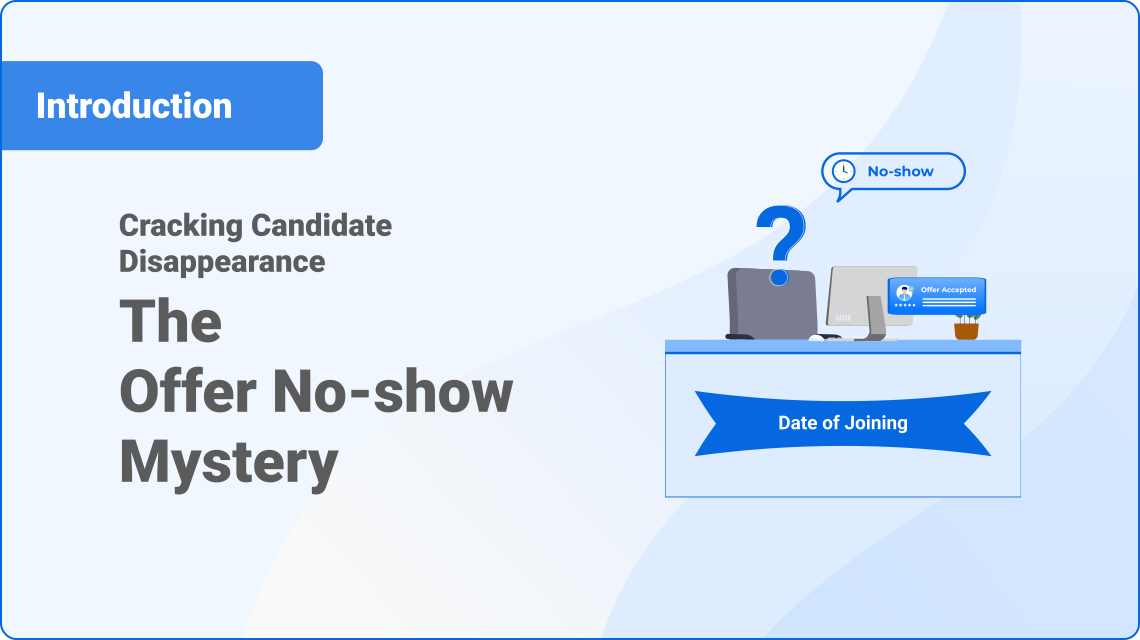
The Offer No-Show Mystery: Your Guide to Cracking Candidate Disappearance
Let's grab a virtual coffee, because we need to talk about something that's probably given you more sleepless nights than a toddler on a sugar rush. You thought closing the offer was the finish line. But in modern hiring, it’s barely the halfway mark.
You know the drill. You've poured your heart and soul into finding that perfect candidate, navigated the labyrinthine demands of hiring managers who want a unicorn but only have hay, and finally, finally, you get that glorious "YES!"
They even acknowledge the offer acceptance, confirm they're serving their notice period, and assure you they're getting ready to join. It's like the heavens open, angels sing, and you can practically feel the firm, confident handshake of your new hire on Day One.
But then… nothing. Just soul-crushing silence.
No reply to the onboarding email. No answer to calls. Messages left unread.
And now, just one day before their supposed start date, the only thing you're hearing is the deafening sound of being ghosted.
It’s the ultimate recruiter gut-punch—an offer accepted, then vanished without a trace.
It almost feels like your candidate pulled a classic trickster move—promising one thing, then slipping into thin air. Mischief, perhaps? Not of the magical kind—but definitely the modern kind. The kind that plays out in inboxes, missed calls, and spiraling dashboards.
Why do candidates say “yes”... only to disappear?
The Illusion of Closure: Why ‘Yes’ Isn’t the Endgame
Let’s call it what it is: the modern hiring paradox.
Candidates say “yes”… but they don’t always mean it
Or at least, not with full conviction.
They say yes, but stay emotionally checked out.
They say yes, but quietly wait to see if something better pops up.
They say yes… then disappear.
The result? Pure chaos for us in talent acquisition:
- Schedules blown to bits: Your carefully crafted time-to-hire metrics? Soaring like a kite in a hurricane.
- Hiring managers breathing down your neck: Trust erosion is faster than a sandcastle in the tide, and the pressure becomes unbearable.
- Team morale quietly deflating: Existing employees feel the strain of those stubbornly unfilled roles.
And you, dear recruiter, back at square one — again. The average cost of a bad hire can be up to 30% of the employee’s first-year earnings. When you have a candidate no-show after an offer, that investment simply vanishes into thin air.
The offer was accepted, offer letter was signed. But in the final reel of your hiring story… your star character vanished from the set. We all joke about ghosting, comparing it to bad dating app experiences, but it's not just annoying; it's financially painful. One talent leader I chatted with recently lamented that five out of his last fifteen accepted offers didn't convert. That’s a 33% drop-off rate!
Gut Check: Your Ghost Rate Risk
How many accepted offers ghosted you in the last 90 days?
| Candidate Ghosting Score | What It Means |
|---|---|
| None (You’re a unicorn.) | Celebrate—and protect your pipeline. |
| 1–2 (You’ve felt the sting.) | You’re on the edge. Time to reinforce post-offer. |
| 3+ (Let’s talk survival strategies.) | You’re bleeding talent. Let’s stop the hemorrhage. |
Imagine an e-commerce site where a third of "checkouts" just vanish. You'd shut it down! But in recruiting, we often just shrug, sip our perpetually burnt coffee, and dive back into sourcing. This candidate drop-off isn't just a challenge; it’s a hemorrhage of time, money, and energy we simply can no longer ignore.
This Isn’t Just a Problem — It’s a Pattern
Here's the kicker: most no-shows aren't doing it to spite you. They're human. And humans, when faced with a seismic life change – new job, new team, new identity – can panic. They hesitate. They overthink. They doubt. And sometimes, they bolt.
This moment of panic is a classic case of what psychologist Leon Festinger called cognitive dissonance — that infuriating mental tug-of-war where their brain goes, "I know I accepted the offer… but am I really sure I want this?"
This discomfort arises when they're holding contradictory beliefs. Suddenly, their current job (even if it's soul-crushing) starts looking cozier than your exciting but unknown world. Maybe they get a counter-offer. A better commute magically appears. Another recruiter calls with an irresistible opportunity. And all of this unfolds while your team is excitedly planning their Day One welcome lunch. This internal conflict doesn't just sit quietly; it festers. This, my friends, is the Post-Offer Fog — where decisions lose all clarity, emotions hijack logic, and your meticulously built hiring momentum quietly unravels. (Picture someone standing at a "Start" button, rocking back and forth, visibly terrified.)
Psych Break: Why “I said yes” doesn’t mean “I’m in.”
Let's dive a bit deeper into the sneaky, often-overlooked psychological forces at play when a candidate ghosted after an offer:
- Cognitive Dissonance: The "I said yes, but…" Scenario.This is the classic mental gymnastics routine. Candidates often accept an offer to buy time, not necessarily to commit wholeheartedly. Their decision might have been perfectly logical on paper, but emotionally fragile. If the tail end of their hiring experience—that last conversation, the post-offer silence, the confusing welcome email—doesn’t resolve their discomfort, they’ll walk away to avoid pain, or worse, to avoid confronting a difficult decision. Inside the Candidate’s Mind: “What if I hate it there? What if I leave and regret it? My boss is annoying but… at least I know what I’m walking into every Monday. Maybe I’ll just… wait.”
- Fear of the Unknown: The Familiarity Trap. Even if a candidate despises their current job, it's familiar. They know the quirks, the norms, where to snag the best chai. Jumping into a new company, even a truly great one, triggers status quo bias, our brain’s stubborn tendency to prefer the familiar over the unfamiliar. Unless your hiring process actively makes the unknown feel safe, their brain screams: “Abort mission! Stay where it’s predictable!” This is a huge offer no-show reason.
- Social Commitment vs. Identity Readiness: The People-Pleaser Paradox. Here's the kicker: sometimes candidates say “yes” just to avoid awkwardness. They want to please you, avoid confrontation, or buy time to weigh other offers. But if their identity hasn’t caught up—if they don’t see themselves as part of your company yet—they’re not emotionally ready. And emotional unreadiness is fertile ground for those soul-crushing last-minute reversals.
Candidate Confessional: "The Silence Was Deafening"
"I said yes to Company A because the offer was good. But after that? Nothing. No messages, no welcome note — just silence. It felt like they forgot about me the moment I acknowledged.
Meanwhile, Company B (who I hadn’t even said yes to yet) was sending updates, introductions, and even memes! They made me feel like I was already part of the team.
Guess where I showed up? Company B.
The silence from Company A was deafening." – A very real candidate, probably still wondering what happened at Company A.
Why Signing Bonuses & Speedy Joins Don’t Fix the Root Problem
When the candidate's no-show after the offer happens, the default corporate response usually sounds something like this:
- "Let’s reduce the notice period!"
- "Let’s throw in a joining bonus!"
- "Let’s follow up more aggressively!"
And sure, these tactics might occasionally work, like slapping a tiny Band-Aid on a gushing wound. But they don’t fix the real issue: the candidate hasn’t made the emotional transformation from ‘applicant’ to ‘future teammate.’ They’ve accepted the job, but they haven’t joined. This is all part of HR dealing with offer no-shows.
“We had cake in the office fridge and a team lunch ready. By 11 a.m., we knew. They weren’t coming.” – An anonymous recruiter, still slightly traumatized.
The “Last Moment” Matters More Than You Think
Here’s the part most companies tragically miss—and it’s absolutely critical. According to the Recency Effect, identified by the brilliant psychologist Hermann Ebbinghaus, people tend to remember the most recent part of an experience better than earlier parts. So, if the very end of the recruitment journey—that crucial post-offer phase—is flat, confusing, or worse, silent, that’s what the candidate remembers most.
Then there’s Daniel Kahneman’s" Peak-End Rule, which states that people judge experiences largely based on just two points:
- The emotional high (or low).
- The ending.
You could have the most seamless interviews, the kindest hiring manager, and the best candidate experience ever, but if the ending is weak? That’s the lingering memory the candidate carries. Even a positive hiring journey can be undone if the final impression is uncertainty, deafening silence, or a complete lack of emotional closure. This is key to how to handle offer no-show situations.
The Invisible Wall in Candidate Experience
And this, my friends, is where most recruitment strategies fall flat on their faces. We invest heavily in sourcing. We obsess over employer branding. We polish every interview touchpoint until it shines. You’ve done all the heavy lifting to get them to "yes." But post-offer? We go silent. We treat the offer letter like the final scene in a feel-good hiring movie—fade to black, roll credits. When in reality, the emotional journey of a candidate is just peaking. This isn’t just a gap in the process. It’s a gaping chasm in transformation. We’re not just talking about getting candidates to say "yes." We’re talking about guiding them through the emotional, psychological, and relational shift that makes them actually show up on Day One. This is all about candidate engagement beyond the offer. That emotional anchor? It’s not luck—it’s a process. More on that in Part 4 when we unlock the Vault.
Recruiter Personas: Meet Ticksy & Trusty
Throughout this series, we’ll contrast two fictional recruiters to highlight the impact of different approaches to candidate engagement after an offer:
Ticksy – The Transactional Recruiter
Ticksy lives for systems, not stories. She relies on offer letters, automated emails, and calendar invites. To her, once the offer is accepted, the mission is complete. But in the silence that follows, candidates disappear. No-shows creep up. Her 40% dropout rate is the price she pays for skipping the human part.
“Signed the offer? Great. See you in 30 days — hopefully.”
Trusty – The Transformational Recruiter
Trusty knows better. She treats every offer as the start of a relationship, not the end of a transaction. She understands the psychology of commitment and builds momentum through trust, empathy, and timely check-ins. Her magic? Turning “I accepted” into “I’m here.” With a 95% Day One show-up rate, ghosting doesn’t stand a chance.
“The countdown doesn’t start at the offer — the connection does.”
Time for a New Approach: Candidate Transformation
This 5-part series is about the deep work of turning that fragile "yes" into a firm commitment—not just occasionally, but consistently. We call it Candidate Transformation—because that’s precisely what needs to happen between the offer letter and Day One.
The candidate needs to shift from:
- “I guess I’ll try this…” To: “I can see myself thriving here.”
- From: “It’s a decent option…” To: “This is my company. My team. My future.”
And trust us, it doesn’t happen by accident. This requires a solution that truly understands candidate psychology and provides the tools to proactively manage the post-offer journey. This is where Connect EC’s Vault Framework™ powers emotional engagement tools like Pix Vault and Vid Vault—designed to support candidate transformation, not just transactions. You don’t need more scripts. You need a new genre. Welcome to the era of Candidate Transformation.
What Not to Do (and What to Do Instead):
❌ Don't: Assume "yes" means "committed."
✅ Do: Recognize that "yes" is a fragile starting point for an emotional journey.
Pro Tip for Recruiters:
Ask yourself: “If I were the candidate, would I feel emotionally welcome right now?”
Even better, ask your team to roleplay as a just-offered candidate. What emotions are triggered between “yes” and Day One?
Let’s stop managing offers and start transforming commitments. Because ghosting isn’t a fluke. It’s feedback.
Ready to rewrite what happens after “yes”? Let’s dive in.
Recruiters Solution01/02
Recruiters
The Offer No-Show Mystery: Your Guide to Cracking Candidate Disappearance
Let's grab a virtual coffee, because we need to talk about something that's probably given you more sleepless nights than a toddler on a sugar rush. You thought closing the offer was the finish line. But in modern hiring, it’s barely the halfway mark.
You know the drill. You've poured your heart and soul into finding that perfect candidate, navigated the labyrinthine demands of hiring managers who want a unicorn but only have hay, and finally, finally, you get that glorious "YES!"
They even acknowledge the offer acceptance, confirm they're serving their notice period, and assure you they're getting ready to join. It's like the heavens open, angels sing, and you can practically feel the firm, confident handshake of your new hire on Day One.
But then… nothing. Just soul-crushing silence.
No reply to the onboarding email. No answer to calls. Messages left unread.
And now, just one day before their supposed start date, the only thing you're hearing is the deafening sound of being ghosted.
It’s the ultimate recruiter gut-punch—an offer accepted, then vanished without a trace.
It almost feels like your candidate pulled a classic trickster move—promising one thing, then slipping into thin air. Mischief, perhaps? Not of the magical kind—but definitely the modern kind. The kind that plays out in inboxes, missed calls, and spiraling dashboards.
Why do candidates say “yes”... only to disappear?
The Illusion of Closure: Why ‘Yes’ Isn’t the Endgame
Let’s call it what it is: the modern hiring paradox.
Candidates say “yes”… but they don’t always mean it
Or at least, not with full conviction.
They say yes, but stay emotionally checked out.
They say yes, but quietly wait to see if something better pops up.
They say yes… then disappear.
The result? Pure chaos for us in talent acquisition:
- Schedules blown to bits: Your carefully crafted time-to-hire metrics? Soaring like a kite in a hurricane.
- Hiring managers breathing down your neck: Trust erosion is faster than a sandcastle in the tide, and the pressure becomes unbearable.
- Team morale quietly deflating: Existing employees feel the strain of those stubbornly unfilled roles.
And you, dear recruiter, back at square one — again. The average cost of a bad hire can be up to 30% of the employee’s first-year earnings. When you have a candidate no-show after an offer, that investment simply vanishes into thin air.
The offer was accepted, offer letter was signed. But in the final reel of your hiring story… your star character vanished from the set. We all joke about ghosting, comparing it to bad dating app experiences, but it's not just annoying; it's financially painful. One talent leader I chatted with recently lamented that five out of his last fifteen accepted offers didn't convert. That’s a 33% drop-off rate!
Gut Check: Your Ghost Rate Risk
How many accepted offers ghosted you in the last 90 days?
| Candidate Ghosting Score | What It Means |
|---|---|
| None (You’re a unicorn.) | Celebrate—and protect your pipeline. |
| 1–2 (You’ve felt the sting.) | You’re on the edge. Time to reinforce post-offer. |
| 3+ (Let’s talk survival strategies.) | You’re bleeding talent. Let’s stop the hemorrhage. |
Imagine an e-commerce site where a third of "checkouts" just vanish. You'd shut it down! But in recruiting, we often just shrug, sip our perpetually burnt coffee, and dive back into sourcing. This candidate drop-off isn't just a challenge; it’s a hemorrhage of time, money, and energy we simply can no longer ignore.
This Isn’t Just a Problem — It’s a Pattern
Here's the kicker: most no-shows aren't doing it to spite you. They're human. And humans, when faced with a seismic life change – new job, new team, new identity – can panic. They hesitate. They overthink. They doubt. And sometimes, they bolt.
This moment of panic is a classic case of what psychologist Leon Festinger called cognitive dissonance — that infuriating mental tug-of-war where their brain goes, "I know I accepted the offer… but am I really sure I want this?"
This discomfort arises when they're holding contradictory beliefs. Suddenly, their current job (even if it's soul-crushing) starts looking cozier than your exciting but unknown world. Maybe they get a counter-offer. A better commute magically appears. Another recruiter calls with an irresistible opportunity. And all of this unfolds while your team is excitedly planning their Day One welcome lunch. This internal conflict doesn't just sit quietly; it festers. This, my friends, is the Post-Offer Fog — where decisions lose all clarity, emotions hijack logic, and your meticulously built hiring momentum quietly unravels. (Picture someone standing at a "Start" button, rocking back and forth, visibly terrified.)
Psych Break: Why “I said yes” doesn’t mean “I’m in.”
Let's dive a bit deeper into the sneaky, often-overlooked psychological forces at play when a candidate ghosted after an offer:
- Cognitive Dissonance: The "I said yes, but…" Scenario.This is the classic mental gymnastics routine. Candidates often accept an offer to buy time, not necessarily to commit wholeheartedly. Their decision might have been perfectly logical on paper, but emotionally fragile. If the tail end of their hiring experience—that last conversation, the post-offer silence, the confusing welcome email—doesn’t resolve their discomfort, they’ll walk away to avoid pain, or worse, to avoid confronting a difficult decision. Inside the Candidate’s Mind: “What if I hate it there? What if I leave and regret it? My boss is annoying but… at least I know what I’m walking into every Monday. Maybe I’ll just… wait.”
- Fear of the Unknown: The Familiarity Trap. Even if a candidate despises their current job, it's familiar. They know the quirks, the norms, where to snag the best chai. Jumping into a new company, even a truly great one, triggers status quo bias, our brain’s stubborn tendency to prefer the familiar over the unfamiliar. Unless your hiring process actively makes the unknown feel safe, their brain screams: “Abort mission! Stay where it’s predictable!” This is a huge offer no-show reason.
- Social Commitment vs. Identity Readiness: The People-Pleaser Paradox. Here's the kicker: sometimes candidates say “yes” just to avoid awkwardness. They want to please you, avoid confrontation, or buy time to weigh other offers. But if their identity hasn’t caught up—if they don’t see themselves as part of your company yet—they’re not emotionally ready. And emotional unreadiness is fertile ground for those soul-crushing last-minute reversals.
Candidate Confessional: "The Silence Was Deafening"
"I said yes to Company A because the offer was good. But after that? Nothing. No messages, no welcome note — just silence. It felt like they forgot about me the moment I acknowledged.
Meanwhile, Company B (who I hadn’t even said yes to yet) was sending updates, introductions, and even memes! They made me feel like I was already part of the team.
Guess where I showed up? Company B.
The silence from Company A was deafening." – A very real candidate, probably still wondering what happened at Company A.
Why Signing Bonuses & Speedy Joins Don’t Fix the Root Problem
When the candidate's no-show after the offer happens, the default corporate response usually sounds something like this:
- "Let’s reduce the notice period!"
- "Let’s throw in a joining bonus!"
- "Let’s follow up more aggressively!"
And sure, these tactics might occasionally work, like slapping a tiny Band-Aid on a gushing wound. But they don’t fix the real issue: the candidate hasn’t made the emotional transformation from ‘applicant’ to ‘future teammate.’ They’ve accepted the job, but they haven’t joined. This is all part of HR dealing with offer no-shows.
“We had cake in the office fridge and a team lunch ready. By 11 a.m., we knew. They weren’t coming.” – An anonymous recruiter, still slightly traumatized.
The “Last Moment” Matters More Than You Think
Here’s the part most companies tragically miss—and it’s absolutely critical. According to the Recency Effect, identified by the brilliant psychologist Hermann Ebbinghaus, people tend to remember the most recent part of an experience better than earlier parts. So, if the very end of the recruitment journey—that crucial post-offer phase—is flat, confusing, or worse, silent, that’s what the candidate remembers most.
Then there’s Daniel Kahneman’s" Peak-End Rule, which states that people judge experiences largely based on just two points:
- The emotional high (or low).
- The ending.
You could have the most seamless interviews, the kindest hiring manager, and the best candidate experience ever, but if the ending is weak? That’s the lingering memory the candidate carries. Even a positive hiring journey can be undone if the final impression is uncertainty, deafening silence, or a complete lack of emotional closure. This is key to how to handle offer no-show situations.
The Invisible Wall in Candidate Experience
And this, my friends, is where most recruitment strategies fall flat on their faces. We invest heavily in sourcing. We obsess over employer branding. We polish every interview touchpoint until it shines. You’ve done all the heavy lifting to get them to "yes." But post-offer? We go silent. We treat the offer letter like the final scene in a feel-good hiring movie—fade to black, roll credits. When in reality, the emotional journey of a candidate is just peaking. This isn’t just a gap in the process. It’s a gaping chasm in transformation. We’re not just talking about getting candidates to say "yes." We’re talking about guiding them through the emotional, psychological, and relational shift that makes them actually show up on Day One. This is all about candidate engagement beyond the offer. That emotional anchor? It’s not luck—it’s a process. More on that in Part 4 when we unlock the Vault.
Recruiter Personas: Meet Ticksy & Trusty
Throughout this series, we’ll contrast two fictional recruiters to highlight the impact of different approaches to candidate engagement after an offer:
Ticksy – The Transactional Recruiter
Ticksy lives for systems, not stories. She relies on offer letters, automated emails, and calendar invites. To her, once the offer is accepted, the mission is complete. But in the silence that follows, candidates disappear. No-shows creep up. Her 40% dropout rate is the price she pays for skipping the human part.
“Signed the offer? Great. See you in 30 days — hopefully.”
Trusty – The Transformational Recruiter
Trusty knows better. She treats every offer as the start of a relationship, not the end of a transaction. She understands the psychology of commitment and builds momentum through trust, empathy, and timely check-ins. Her magic? Turning “I accepted” into “I’m here.” With a 95% Day One show-up rate, ghosting doesn’t stand a chance.
“The countdown doesn’t start at the offer — the connection does.”
Time for a New Approach: Candidate Transformation
This 5-part series is about the deep work of turning that fragile "yes" into a firm commitment—not just occasionally, but consistently. We call it Candidate Transformation—because that’s precisely what needs to happen between the offer letter and Day One.
The candidate needs to shift from:
- “I guess I’ll try this…” To: “I can see myself thriving here.”
- From: “It’s a decent option…” To: “This is my company. My team. My future.”
And trust us, it doesn’t happen by accident. This requires a solution that truly understands candidate psychology and provides the tools to proactively manage the post-offer journey. This is where Connect EC’s Vault Framework™ powers emotional engagement tools like Pix Vault and Vid Vault—designed to support candidate transformation, not just transactions. You don’t need more scripts. You need a new genre. Welcome to the era of Candidate Transformation.
What Not to Do (and What to Do Instead):
❌ Don't: Assume "yes" means "committed."
✅ Do: Recognize that "yes" is a fragile starting point for an emotional journey.
Pro Tip for Recruiters:
Ask yourself: “If I were the candidate, would I feel emotionally welcome right now?”
Even better, ask your team to roleplay as a just-offered candidate. What emotions are triggered between “yes” and Day One?
Let’s stop managing offers and start transforming commitments. Because ghosting isn’t a fluke. It’s feedback.
Ready to rewrite what happens after “yes”? Let’s dive in.